
Geopolitical tensions in the Indo-Pacific have surged once again.
Analyses, war-game simulations, and strategic forecasts increasingly revolve around the triangular relationship between Japan, China, and Taiwan. The newly elected Japanese prime minister, Sanae Takaichi, is entering a term that is already shaping up to be unusually tense. Her administration will face a regional environment defined by naval rivalry, strategic mistrust, and the growing possibility of a military showdown around Taiwan.
In that context, attention is returning to one of Tokyo’s most dangerous and least publicized assets – a system that has worried Chinese military planners for years.
It is Japan’s silent, hidden advantage beneath the waves.
Japan’s Superweapon That Troubles Beijing
China is today the world’s largest navy by number of ships, with more than 370 vessels currently in service. Projections suggest that by the end of this year Beijing could field around 395 ships, and by 2030 at least 435. Yet, despite its enormous shipbuilding capacity and rapid expansion, China still faces a critical vulnerability: a weak anti-submarine warfare capability.
The United States Navy, by comparison, maintains fewer ships, expected to have around 294 vessels by 2030, but it still dominates in categories that matter most for power projection, such as nuclear submarines and aircraft carriers. Japan, however, relies on a completely different concept of projecting power. Tokyo cannot compete numerically with China’s vast fleet, nor does it attempt to. Instead, Japan possesses a capability that represents an existential threat to China’s carrier groups and amphibious invasion forces: a fleet of ultra-quiet AIP submarines.
For Beijing, this is not simply a theoretical concern. It is one of the core operational challenges that could determine the outcome of any future conflict in the Taiwan Strait.
Why China Fears Japan’s Submarine Fleet?
China currently operates around 60 submarines, including 12 nuclear-powered vessels. Yet Chinese commanders are well aware that Japan has something far harder to detect, intercept, or neutralize.
Most of Japan’s submarines are equipped with Air-Independent Propulsion systems, which allow them to remain submerged far longer than conventional diesel-electric submarines and operate with extraordinary quietness. In modern undersea warfare, silence is survival. In the narrow and strategically vital waters west of Japan, silence also becomes a weapon.
If China were ever to launch an offensive against Taiwan, Japan’s submarines, guided by U.S. intelligence and operating under joint command structures, could play a decisive role.
The Structure of Japan’s Submarine Force
Japan maintains roughly twenty-two to twenty-three active submarines, though the broader fleet that includes vessels under construction or entering service can reach twenty-six to twenty-eight. The majority come from three main classes.
Seven submarines belong to the Oyashio class.
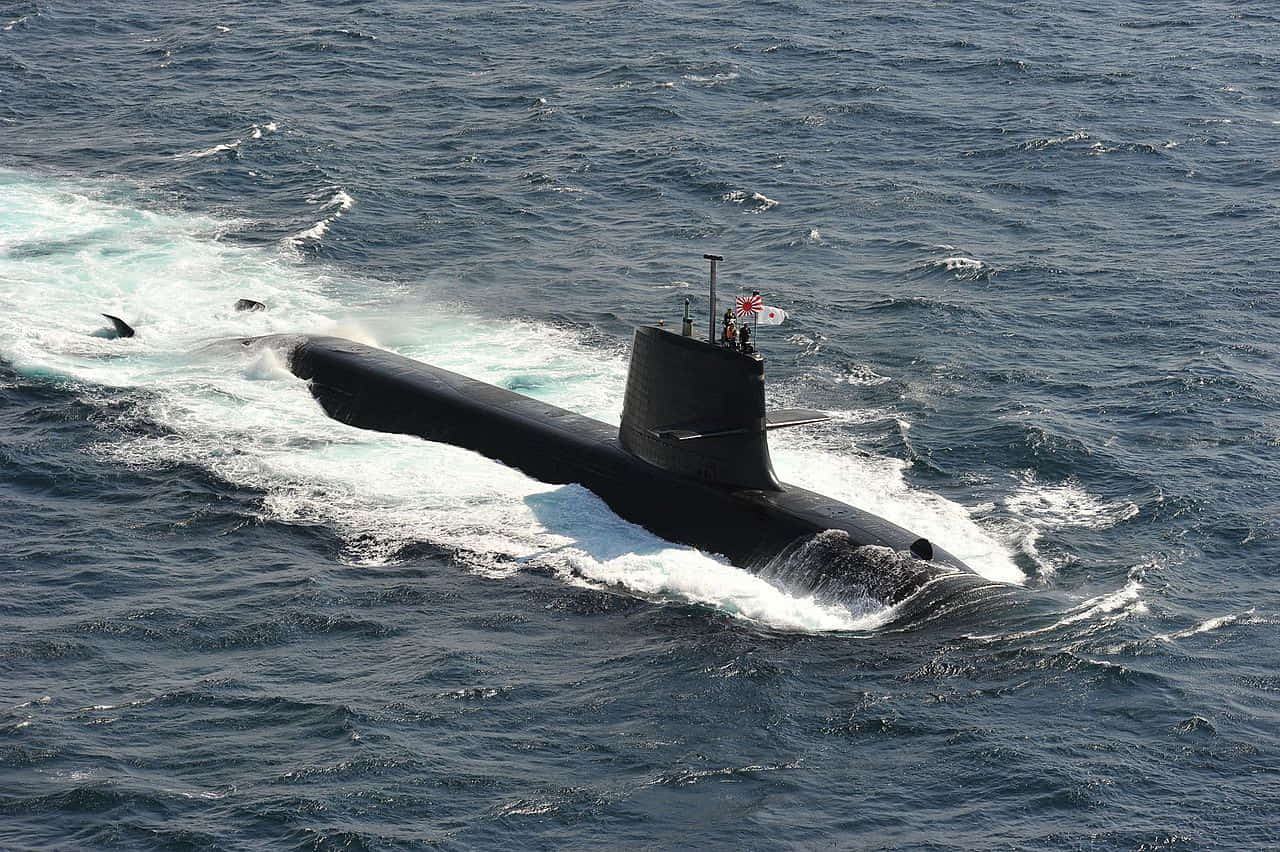
Twelve are from the Sōryū class, ten of which incorporate advanced artificial-intelligence-based systems that improve navigation, battery efficiency, and tactical management.
Four belong to the newest Taigei class, which represent the most technologically advanced conventional submarines Japan has ever deployed. Unlike the Sōryū, they do not use AIP, but rely on cutting-edge lithium-ion batteries that offer faster recharging, higher power density, and superior endurance.
All of these submarines are attack submarines designed to eliminate surface combat groups, which makes them direct threats to Chinese carrier strike groups and amphibious assault formations. The Sōryū class, introduced in the early 2000s, remains one of the world’s most sophisticated conventionally powered submarines ever built. With a submerged displacement of 4,200 tons and a length of eighty-four meters, the Sōryū is also one of the largest non-nuclear submarines in global service.
Japan’s newer Taigei-class boats push this capability even further. Their advanced sensors, improved stealth features, and powerful new batteries provide the kind of silent endurance that is extremely difficult for China’s current detection systems to counter.
🇯🇵Japan just launched its 6th Taigei-class submarine in Kobe — the world’s most advanced diesel-electric attack sub.
¥736 billion beast, launched Oct 14, enters service March 2027.
One new boat launched + one commissioned every single year like clockwork.
Six Taigei-class now… pic.twitter.com/g9DM0R3hTB— Defense Intelligence (@DI313_) November 20, 2025
Quieter Than Chinese Submarines: The Core of Beijing’s Concern
Defense specialists have long argued that Japanese submarines are significantly quieter than their Chinese counterparts. This is not a minor technical detail; it is the foundation of operational advantage in submarine warfare. The quieter submarine can observe, track, and strike first.
For China’s military strategists, this is the central obstacle to any large-scale operation near Taiwan. Japanese submarines, acting as underwater ambush platforms, could disrupt Chinese efforts at multiple levels. They could sever supply routes leading toward Taiwan. They could destroy key ships carrying logistical equipment for an invasion. They could strike at carrier groups responsible for air cover. They could target command ships and amphibious transports bringing troops to the beaches.
In other words, Japan possesses a system that could fundamentally destabilize any Chinese military operation across the Taiwan Strait, particularly if the United States authorizes and coordinates its use.
Japan does not advertise this capability loudly. It does not need to. Chinese analysts already understand the threat, and it is precisely this quiet, invisible force beneath the waves that keeps planners in Beijing awake at night.